
Google Fiber, the fiber-optic Internet service, is one of the most popular offerings from Alphabet. Though it is not widely available across the United States, Google Fiber has managed to become a user favorite in the locations where it is available. In this article, we shall look at some interesting facts and statistics on Google Fiber and its plans. We shall start with a company overview and then move to specifics.
Company Overview
Here is a quick overview of Google Fiber and how the company has grown over the last decade.
- Google Fiber, stylized as GFiber, was founded in 2010 by Google. It subsequently became a subsidiary of Alphabet Inc.
- The prime objective of Google Fiber is to offer high-speed fiber-optic Internet service across the US, but it also provides telephone and TV services in many locations.

- Although the company is headquartered in Mountain View, CA, the service locations have continued to expand, reaching urban and suburban areas in many states.
- Since its inception, Google Fiber has focused on providing all-inclusive services with a straightforward pricing plan, no annual contracts, and data caps.
- Google Fiber has priced its base plan at $70 per month, offering a speed of 1 Gbps. Although the ISP has introduced more expensive plans, the base plan has retained the same price for over a decade.
- Unlike most ISPs out there, all fiber-optic Internet plans from Google Fiber are symmetric, meaning that you get the same upload and download speeds.
- Though it began its services in Kansas, GFiber has expanded its serviceable area to serve cities in 19 states, including Austin, Atlanta, Charlotte, Nashville, Salt Lake City, San Antonio, Huntsville, etc.
- The fastest Internet plan from Google Fiber has a symmetrical speed of 8 Gbps. This means that a user can download or upload a 1GB file in just about a second.
- The company has been experimenting with higher speeds for residential connections and might soon offer speeds as high as 20 Gbps.
- Google Fiber has acquired multiple companies over time, including Webpass, which uses millimeter wave technology for high-speed urban internet.
- Compared to other Internet Service Providers in the United States, Google Fiber is known as a more customer-friendly option, primarily due to its transparency.
- Google Fiber is also considered a market disruptor because its presence has resulted in better-priced Internet services in multiple markets.
- Since its beginning, Google Fiber has established and experimented with different ways to lay fiber-optic cables, including the use of existing utility poles.
- Though not realized, Google Fiber had this original dream of being an open network that ISPs could use across the US.
- Google Fiber has scored 76 on the American Customer Satisfaction Index, a score that most other ISPs cannot match.
Best Value Internet Providers (Customer Satisfaction Insights)
- GFiber leads the pack with a customer satisfaction rate of 80%, making it the top choice for internet value in 2026.
- T-Mobile secures second place with 78% of customers reporting they were completely or very satisfied with their service.
- Starlink follows closely at 77%, showing strong approval among users, particularly in rural and underserved areas.
- Metronet holds a respectable 72% satisfaction score, reflecting solid performance in fiber internet offerings.
- Armstrong rounds out the top five with a 71% satisfaction rate, still maintaining a decent value perception among its customers.

Google Fiber Popular Plans
Now, we shall look at the popular Internet plans from Google Fiber.
- One interesting thing about Google Fiber is that all plans from the company offer a Wi-Fi 6E mesh router that can provide whole-home coverage.
- As of 2026, the company offers the Nest Wi-Fi modules with its popular plans. Depending on the plan, you may get one or two extenders.

- All Internet plans from Google Fiber are free from data caps and contracts. This means you can access as much data as you want at the speed you have purchased the plan.
- The base plan from Google Fiber, called Core 1 Gig, will cost $70 per month and offers a top speed of 1 Gbps.
- The second plan, called Home 3 Gig, will set you back by $100 per month, and the maximum speed is 3 Gbps downloads and uploads.
- The third plan, named Edge 8 Gig, is the fastest plan you can get at $150 per month. Here, the speed will be 8 Gbps.
- The Edge 8 Gig plan also offers a Multi-Gig Wi-Fi 6E router along with two extenders. The setup must be powerful enough to cover homes and offices as large as 5,000 sq. ft.
- All Google Fiber Internet plans are symmetrical, meaning that you can enjoy near-identical download and upload speeds through the connection.
- Users can add a few add-ons, such as a home phone connection and internal battery backup, when they pay $10 per month.
- The average latency of popular Internet plans from Google Fiber is 13 milliseconds, making them so great for time-intensive tasks like online gaming and content streaming.
- In addition to these major plans, 2-Gig and 5-Gig plans are also available in some markets. They are priced at $100/month and $125/month, respectively.
- Users in some urban areas can also explore wireless Internet plans from Google Fiber. These plans, provided through Webpass, offer speeds between 100 Mbps and 1 Gbps.
- Most of these Google Fiber plans are available in select metro areas across 19 states and DC, with ongoing expansion making them available in more states.
- In comparison to other ISPs in the market, Google Fiber offers the lowest per-Mbps cost. For instance, with the 1 Gig plan, you pay only 7c per Mbps.
- As you move towards high-priced, faster plans, the per-Mbps cost comes down. The 3 Gig plan brings the per-Mbps cost down to 3c.
- All Google Fiber plans come with a 10-minute installation window appointment. This means users do not have to wait for hours to get started with Google Fiber.
- Free professional installation is also included with each plan; there are no hidden fees attached to it.
- In some locations, eligible households can access Google Fiber Internet services for free or at a lower cost through the Affordable Connectivity Program.
- Earlier, some Google Fiber plans used to offer 1TB of Google Drive cloud storage. This option doesn’t seem to be available in 2026, though.
- Google Fiber is one of the few ISPs that offer a mesh Wi-Fi router with its base router.
Upload Speed Matters: What Internet Shoppers Value
- 49% of respondents said upload speed is “very important” when choosing an internet provider.
- 34% consider it “important”, highlighting that a combined 83% value upload performance.
- 14% feel “indifferent” about upload speed during the selection process.
- Only 3% rated upload speed as “unimportant or very unimportant”, showing it’s a minor concern for very few.

Google Fiber Revenue Statistics
Here are some statistics based on the limited data we have about Google Fiber’s revenue.
- Google Fiber doesn’t contribute a lot to the overall revenue of Alphabet Inc., its parent company. As per the report from Alphabet, the revenue from Google Fiber is included in a category called “Other Bets and Access Business.”
- However, multiple sources have speculated on Google Fiber’s total revenue. Some sources report a revenue of $750 million as of June 2026.
- Nevertheless, the rise in the number of employees and the expanded availability indicate that GFiber has had a good performance streak.
- In the past year alone, there was an employee growth rate of 65%, showing that Google Fiber has been expanding.
- It is unclear whether the revenue reports consider the profit derived from Webpass, a company that GFiber had acquired in the past.
How Often Do Google Fiber Users Face Outages
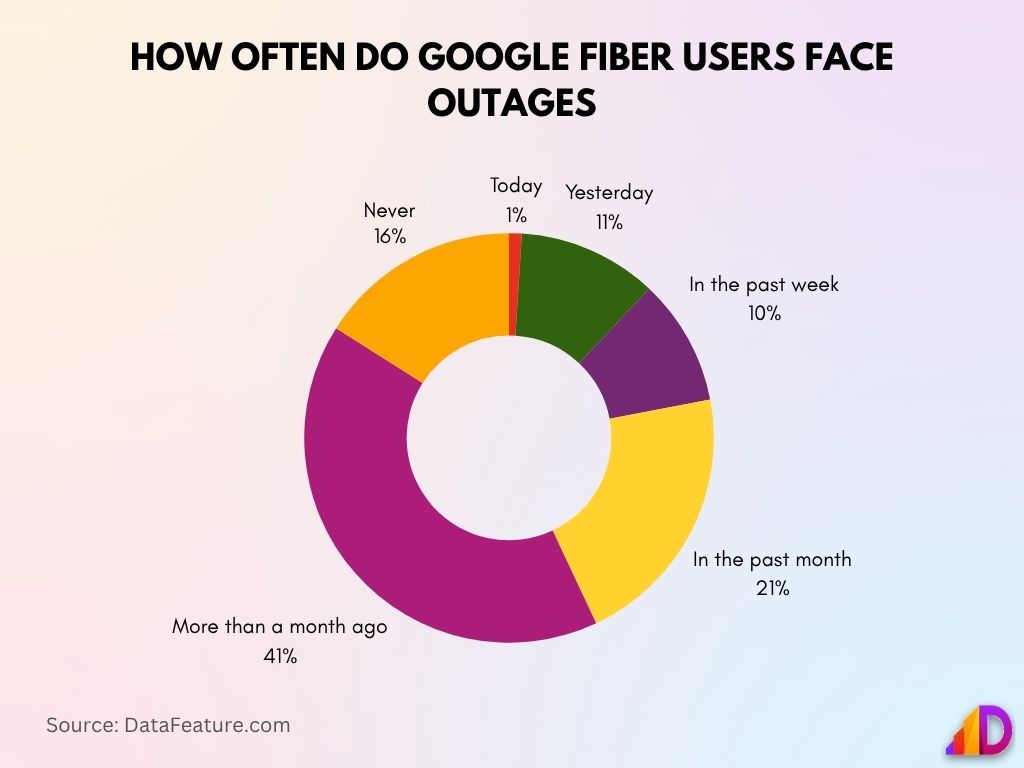
- 41% of respondents said their last Google Fiber outage was over a month ago, indicating a relatively stable service for most users.
- 21% experienced an outage within the past month, showing some minor recent disruption.
- 16% reported never having a Google Fiber outage, a strong testament to reliability for a portion of customers.
- 11% had an outage just yesterday, while 10% faced one in the past week, highlighting short-term service issues for some.
- Only 1% experienced an outage today, suggesting very few users are facing immediate issues.
Google Fiber Users
Here is what we know about Google Fiber’s user base and usage practices.
- The latest public estimation of the number of users of Google Fiber was in 2016. In that year, it was reported that Google Fiber had 453,000 users.
- Considering how Google Fiber has expanded its operations in the past 9 years, the number is likely to have doubled or tripled.
- In the last 12 months, over 1.76 million speed tests were done by Google Fiber. It is another way to understand the rising user base of Google Fiber.
- In 2026 and 2026, Google Fiber expanded its operations by launching the services in more cities and expanding the connectivity to more urban areas. The acquisition of Webpass has also assisted GFiber in this regard.
- Based on multiple surveys, most customers are happy with Google Fiber’s Internet services. The ISP has shown incredible user response in multiple surveys on Internet service satisfaction.
- Despite its limited availability, Google Fiber is considered one of the top overall ISPs in the USA.

- Google Fiber’s participation in the Affordable Connectivity Program has also been instrumental in the strengthening of its user base, as the program makes Internet access more affordable.
- When Google Fiber started its operation, it mandated users not to use the service to run servers. This mandate was later changed, allowing users to rely on the service for personal-use servers.
- Despite being available in metro areas across 19 states and parts of Washington, DC, Google Fiber is available to only 1% of the US households, showing the limitation in terms of market penetration.
- According to the FCC Broadband Consumer label of the company, Google Fiber does not charge any sort of equipment rental, early termination, or equipment installation fees.
Fiber Optics Market Growth Forecast
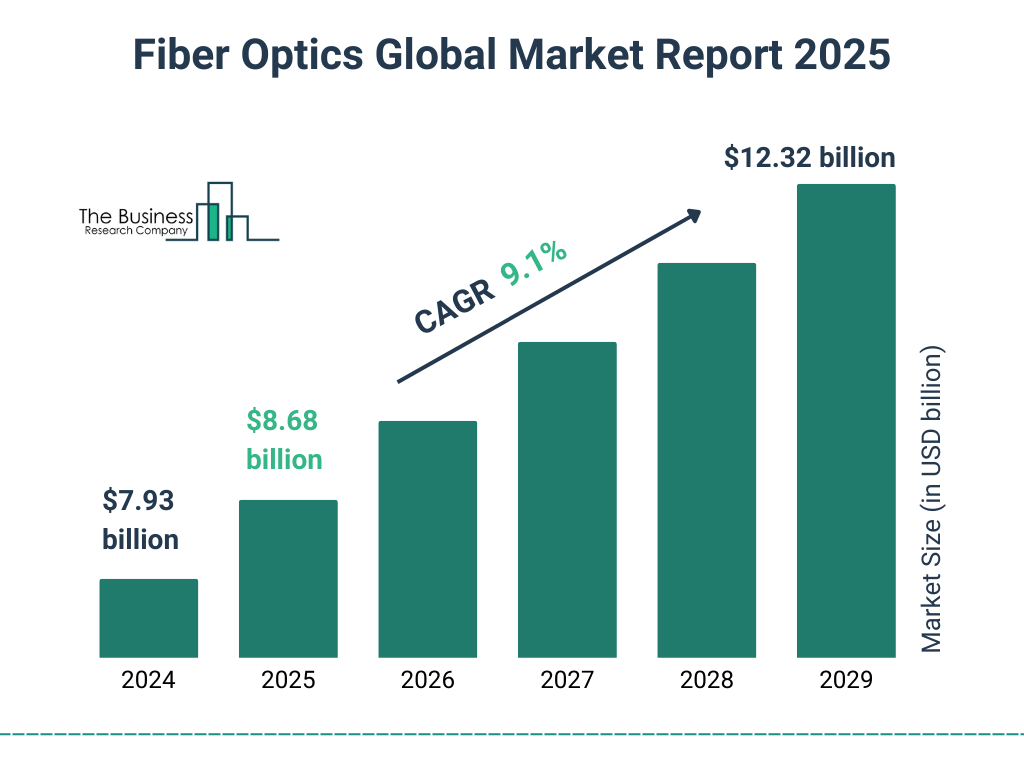
- The fiber optics global market is projected to grow from $7.93 billion in 2026 to $12.32 billion by 2029.
- In 2026, the market is expected to reach $8.68 billion, showing steady expansion.
- The industry is forecasted to grow at a CAGR of 9.1%, signaling strong long-term demand and investment potential.
- Market size continues to rise year-on-year: 2026, 2027, and 2028 all show consistent growth, culminating in $12.32 billion by 2029.
Google Fiber Market Impact
Google Fiber has been an exemplary ISP so far, with implications for the market.
- Google Fiber has had an overall positive impact on the ISP market, helping improve the standards for internet speed. Between 2026 and 2026, the median download speed in Mesa, Arizona, increased by 50%.
- However, the biggest increase in median download speed was registered in Kansas, where Google Fiber was first launched. In Kansas, there was a surge of 86%.
- In response to the new standard set by Google Fiber, ISPs like AT&T and Time Warner Cable launched multi-Gigabit Internet plans without charging extra costs.
- Studies have also shown that the presence and expansion of Google Fiber have pushed the number of 1 Gbps connections in the United States by a long shot.
- The FCC’s decision to raise the broadband benchmark to 100 Mbps/2 Mbps with an expectation to 1 Gbps/500 Mbps can be considered a long-term impact of the changes brought about by GFiber.
- Google Fiber is now planning to make use of advanced XGS-PON and 25G-PON fiber technologies to offer speeds as high as 20 Gbps for residential and enterprise connections.
- Initiatives by Google Fiber to lay expansive fiber infrastructure have also resulted in many decisions to ease regulatory restrictions on setting up fiber systems.
- The long-term impacts of Google Fiber also include the decision by many local governments to set up open network infrastructures.
Conclusion
It becomes clear that the growth of Google Fiber has benefited customers in multiple ways. One, it has made super-fast Internet accessible to many without spending a lot. More importantly, Google Fiber has also been a positive factor in market change, pushing the broadband benchmarks to improve.
As we saw, many ISPs have also improved the average speed of their Internet plans, responding to the rising popularity of Google Fiber connections. Given that the company is planning rigorous expansion, we should be seeing higher-speed Internet connections across the US in the coming years.