
When Starlink was launched, not many anticipated the success it would achieve in the upcoming years. These days, Starlink has become a formidable competitor to not only satellite-based internet service providers but also players from sectors like wireless fixed access. In this article, we have curated some interesting statistics and facts about Starlink, including the number of subscribers, satellites, etc. We will start with some general facts about the satellite Internet service.
General Starlink Stats & Facts
Here are some interesting stats and facts about Starlink:
- The name Starlink refers to the satellite Internet constellation that orbits the Earth in order to provide Internet access to anyone with a Starlink dish.
- The service provider is called Starlink Services LLC, and this company is a subsidiary of SpaceX, a much popular aerospace company owned by Elon Musk.
- At the time of writing, Starlink services are available in over 125 countries across the world. Starlink is in talks with many other countries to expand services in more areas.
- In addition to satellite internet, satellite cellular services are also available from Starlink. Starlink also offers a dedicated service called Starshield for governmental needs, offering encryption and safety.
- Interestingly enough, the name Starlink was inspired by the book titled The Fault in Our Stars, written by John Green.

- The latest version of Starlink satellites weighs around 1,760 lbs., which is heavier than the previous-generation satellites. Each satellite is designed to serve for 5 years before getting replaced.
- In the next decade, the Starlink constellation will have a total of 42,000 satellites in the collection and can cater to more customers than it can right now.
- Starlink has launched so many satellites within the past six years that the company is now responsible for over 50% of the satellites orbiting the Earth.
- The satellite internet service from Starlink offers an average speed of 25 to 220 Mbps for download and 5 to 20 Mbps for upload.
- The orbit altitude of Starlink satellites is 342 miles, putting them in Low Earth orbit. This placement is instrumental in the high speeds Starlink provides compared to other services.
- Even though Starlink cannot compete with the speeds that 5G Internet provides these days, it steals the show when it comes to providing Internet access in remote areas.
- Starlink is also one of the few services available in Antarctica, where research personnel continuously use the service for Internet access.
- Even though Starlink requires ground stations to provide Internet access to customers, the satellites can communicate with each other on their own. SpaceX developed a laser-based technology for this.
- The Starlink system also creates a mesh network that assists the constellation to add redundancy. It is also instrumental in offering seamless coverage from anywhere on Earth.
- Starlink has big plans to expand the constellation in 2026 and plans to do it with the help of Falcon 9 launches, 38 of which are already scheduled.
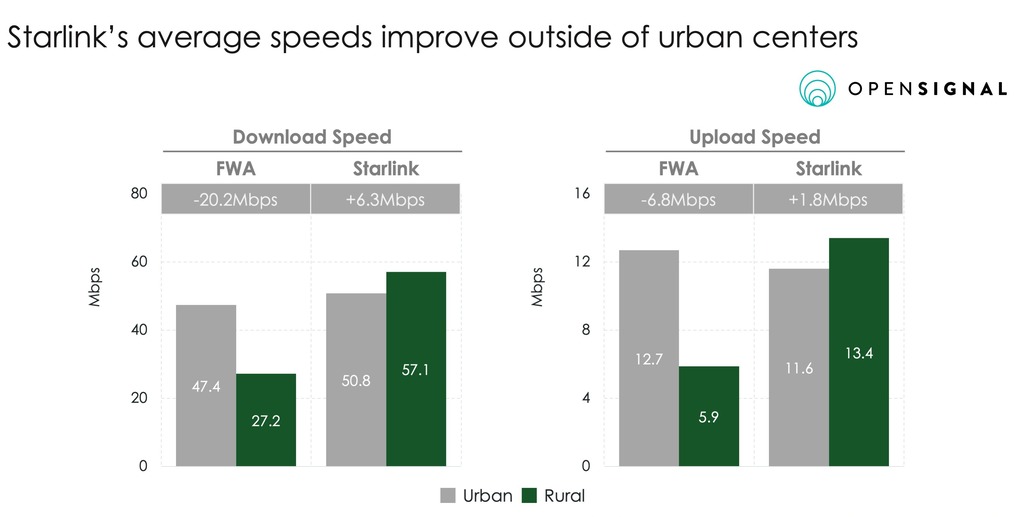
Starlink and FWA Speeds: Urban vs Rural Performance
- Starlink Download Speed (Urban): 50.8 Mbps: In urban areas, Starlink delivers an average download speed of 50.8 Mbps. This is lower than its rural performance, showing room for optimization in cities.
- Starlink Download Speed (Rural): 57.1 Mbps: In rural areas, Starlink achieves an improved download speed of 57.1 Mbps. That’s a +6.3 Mbps increase compared to urban speeds.
- FWA Download Speed (Urban): 47.4 Mbps: Fixed Wireless Access (FWA) reaches 47.4 Mbps download speed in urban zones. This is its best performance area compared to its rural counterparts.
- FWA Download Speed (Rural): 27.2 Mbps: In rural settings, FWA drops to just 27.2 Mbps download speed. That marks a significant -20.2 Mbps decrease from urban averages.
- Starlink Upload Speed (Urban): 11.6 Mbps: Starlink offers 11.6 Mbps average upload speed in urban locations. This figure improves when moving outside city areas.
- Starlink Upload Speed (Rural): 13.4 Mbps: Rural users experience better Starlink upload speeds, averaging 13.4 Mbps. That’s a +1.8 Mbps gain over urban upload performance.
- FWA Upload Speed (Urban): 12.7 Mbps: FWA records 12.7 Mbps upload speed in urban areas. It outperforms Starlink in city-based upload tests.
- FWA Upload Speed (Rural): 5.9 Mbps: In rural areas, FWA’s upload speed drops sharply to 5.9 Mbps. This represents a -6.8 Mbps decrease from its urban result.
Starlink Subscribers
Over the years, Starlink has been expanding to many countries, and we can witness a growth in the number of subscribers. Here are some statistics on Starlink subscribers/customers.
- It must be noted that Starlink does not differentiate between subscribers, customers, and users. The company, instead, uses the term customers.
- As of April 2026, Starlink is expected to have over 5.5 million customers globally. The customer base had a noticeable growth in 2026, as the total number was only 4.6 in December 2026.
- The most significant growth in Starlink subscribers has been between April 2026 and April 2026. In April 2026, the company had only 2.69 million customers, but it jumped to 5.5 million by April 2026.
- Starlink recently launched a contract-based plan that would offer the installation equipment free of cost. This plan is expected to increase the subscriber base in the long run.

- Market projections predict that Starlink will close to 8 million customers by the end of 2026, owing to the increasing demand for Internet access in remote areas.
- In addition to standard Internet plans, the RV-based Starlink plans have also been instrumental in the increasing number of Starlink users.
- For starters, the company only had about 10,000 Starlink customers in February 2021, indicating the magnitude of growth it has achieved in the past half decade.
- One challenge for Starlink in increasing the customer base has been the difficulty in getting regulatory approvals in many countries, including many South Asian nations.
- However, there are reports of unauthorized use of Starlink in countries like Gambia, Cameroon, Sudan, Myanmar, and Venezuela.
- The increasing number of subscribers has had an impact on the average speed of the service. Starlink is now focusing on expanding the constellation to combat this restriction.
Per Country
We shall now look at how Starlink performs in different countries with respect to the number of customers.
- The number of Starlink customers has reached a saturation point in many places, like North America and Europe, alongside New Zealand and Australia.
- More users of Starlink are emerging from countries where Starlink is expanding its internet service. The company does not seem to focus on increasing market penetration in existing regions.
- India is expected to be a huge market for Starlink due to the population and the presence of areas where conventional telecommunication technology cannot be relied upon.
- Market analysts predict that the Indian market can help add up to 5 million customers to the Starlink customer base by the end of 2030, given the regulatory approval.

- The highest number of Starlink customers is from the United States, with 1,200,000 users as of 2026.
- In the second, third, and fourth positions are Canada, the United Kingdom, and Germany. There is no significant contribution from South Asian countries at the time of writing.
- Market analysts are unanimous in mentioning the growth potential Starlink will have in India once it goes through regulatory approval, given that the pricing is also on point.
- Brazil is another growing market in terms of Starlink customers. The growth has been so intense that authorities are worried about overreliance on Starlink.
- Starlink seems to attract more customers from markets where the satellite internet service delivers higher speeds than terrestrial alternatives. Africa is an example of this category.
- Starlink’s introduction of Direct-to-Cell services will increase the number of subscribers in the coming years, especially in the United States.
Internet Providers Ranked by Customer Satisfaction on Speed (2026 Survey)
- Starlink leads the pack with a 95% satisfaction rate for internet speed. Nearly all customers were either completely or very satisfied with its performance.
- GFiber comes in second with 85% of users reporting high satisfaction with speed. It’s a strong fiber-based alternative to satellite internet.
- Xfinity secures third place with an 81% satisfaction rate. A majority of its users are pleased with the speed it provides.
- Verizon follows closely with 80% satisfaction, showing consistent approval for its internet speeds. It remains a reliable option among traditional ISPs.
- Metronet rounds out the list with a still-impressive 79% customer satisfaction. Despite being at the bottom of the list, it maintains a competitive score in speed satisfaction.

Total Satellites
Starlink has been focusing on expanding the satellite constellation since its inception. Here are some stats on the number of total satellites.
- Starting in 2019, Starlink launched over 7,400 satellites into Low Earth Orbit. Out of these, over 7100 satellites are active at this point.
- Starlink plans to expand the number of satellites to 12,000 by the end of the initial phase. In the future, the company expects to increase the number to 30,000+ to meet the increasing requirements.
- As of 2026, Starlink had to deorbit close to 300 satellites due to technical and performance issues. However, it does not affect the performance of the Starlink network or constellation.
- Starlink has planned quite a few satellite launches in 2026, so that the total number would hit the 8000 mark by the end of the year.

- In May 2026 alone, Starlink will be adding over 300 new satellites to the constellation, compensating for the increasing number of subscribers.
- For reference, the first launch from Starlink had only 60 satellites in the collection. However, within the next three years, the company increased the size of the constellation by 6,000.
- It is recorded that Starlink launched a whopping 1,900 satellites between November 2026 and May 2026.
- The Falcon 9 Booster has been instrumental in increasing the size of the Starlink constellation. This rocket has been reused multiple times for the purpose of constellation expansion.
No of Active Satellites
- According to multiple sources, Starlink has between 7100 and 7200 active satellites in the constellation, all of which form a mesh network to serve customers across the globe.
- However, the exact number would have increased, given that the company plans to launch over 300 satellites in May 2026 alone.
- Satellites from Starlink are designed and optimized to avoid collisions, improve their effectiveness, and avoid space waste.
- The latest T3 satellites from Starlink are equipped with direct-to-cell capacity, which allows users to enjoy cellular services even when in remote areas.
- For the purpose of cellular access, Starlink has partnered with T-Mobile in the United States. One can expect further collaboration in other countries.
Starlink Download Speeds Vary Widely Across Europe
- Hungary tops the chart with the fastest Starlink median download speed at 135.11 Mbps. It’s the leading performer among all European countries.
- Greece and Croatia follow closely with 131.36 Mbps and 130.4 Mbps, respectively. Both countries outperform many Western European nations.
- Finland and Portugal offer strong speeds as well, clocking in at 124.97 Mbps and 124.47 Mbps. These are among the top five in Europe.
- Romania, Ireland, and Slovenia all show excellent performance, each surpassing 110 Mbps. This highlights Starlink’s strength in diverse regions.
- Sweden and Austria report solid speeds of 110.88 Mbps and 104.53 Mbps, rounding out the group above the 100 Mbps mark.
- Italy and Denmark come in just below, with 101.89 Mbps and 96.96 Mbps. Both maintain good regional averages.
- Germany (52.02 Mbps) and Poland (51.89 Mbps) are near the lower end of the spectrum. This suggests room for network improvements.
- Cyprus ranks lowest with a median speed of just 36.52 Mbps. It’s the only country under 40 Mbps on the list.
- Overall takeaway: Starlink’s performance in Europe is highly regional, ranging from 135 Mbps in Hungary to 36 Mbps in Cyprus.

Global Market Share
Here are some numbers on the market share of Starlink and how it compares with other service providers.
- With the highest number of satellites in Low Earth Orbit, Starlink seems to dominate the market in terms of the number of subscribers.
- Dedicated features like unlimited usage and high speeds have been instrumental in increasing the overall popularity of Starlink’s services across the globe.
- Even though companies like Hughes and Eutelsat have been in the industry for a while, neither of them is able to compete with Starlink.
- Project Kuiper from Amazon and OneWeb are considered serious competitors to Starlink, but they have yet to be launched.
- The satellite internet market is expected to have a total valuation of $25.67 billion by 2032, and the lion’s share will be held by Starlink alone.
Satellite Internet Market Growth Forecast (2026–2034)
- In 2026, the satellite internet market is projected to reach $11.93 billion, showing early momentum in global adoption.
- By 2026, the market will grow to $13.55 billion, indicating steady year-over-year expansion.
- In 2027, the market is expected to hit $15.40 billion, driven by increased demand for rural and remote connectivity.
- The year 2028 forecasts a rise to $17.50 billion, reflecting ongoing infrastructure improvements and satellite launches.
- By 2029, the industry will grow further to $19.88 billion, closing in on the $20B milestone.
- In 2030, the market is set to cross that mark, reaching $22.59 billion, nearly doubling from 2026 levels.
- 2031 projects another leap to $25.66 billion, highlighting strong long-term investor and consumer confidence.
- By 2032, the market is anticipated to hit $29.16 billion, reinforcing its upward trajectory.
- The year 2033 is expected to bring the market size to $33.13 billion, showing acceleration in adoption.
- By 2034, the satellite internet market will reach a projected $37.64 billion, more than tripling in size since 2026.

Starlink Revenue Statistics
Here are some numbers on Starlink’s revenues.
- Corresponding to the number of customers across the globe, Starlink’s revenue has also been on the rise.
- In 2026, the company had a total revenue of $7.7-$8.2 billion, and this was a noticeable growth from 2026.
- Market forecasts suggest that the company will have a total revenue of $11+ by the end of 2026, as Starlink is due to get regulatory approval in many countries.
- The largest share of Starlink’s revenue appears to be from consumer services, which refers to service costs paid by Starlink customers.
- The company also receives a huge amount—close to $3 billion—from US government contracts, for which the firm has landed in controversy as well.
- To compete with local players in the market, Starlink has been optimizing the pricing of its services. For instance, Starlink is available for $120 per month in the US, but the monthly costs are $40 and $30 in France and Brazil, respectively.
Wrapping Up
We believe these statistics helped you understand the growth of Starlink. As the company focuses more on launching new satellites and getting regulatory approvals, the numbers will only grow. If anything, people’s need to stay connected even when in remote locations is increasing day by day. This means that the satellite internet sector is also due for an upsurge.