
Let’s be honest—you probably never think about favicons until they’re missing. That sad blank square sitting in your browser tab practically screaming “this company doesn’t have its act together.” The favicon—that tiny 16×16 pixel square most people completely overlook—can absolutely make or break brand recall in our tab-hoarding digital landscape.
From Internet Explorer’s janky blob icons to today’s slick SVG masterpieces, these microscopic brand ambassadors have evolved from afterthought to essential. Stick with me, and I’ll show you why this tiny square might be the most underrated asset in your entire brand toolkit.
Brief History of Favicons
Favicons crawled out of the primordial digital soup back in 1999 with Internet Explorer 5 (yes, that prehistoric nightmare). Microsoft basically said, “here’s this cool thing” and then implemented it in the most Microsoft way possible—by forcing everyone to use their proprietary .ico format.
The evolution went something like:
- 1999: Basic .ico files (Internet Explorer’s fault)
- 2003: PNG support starts appearing (thank god)
- 2015: SVG support finally arrives (where were you all my life?)
Browser wars shaped how favicons developed—if Chrome didn’t support something, designers wouldn’t use it. Period. What started as static blobs for websites eventually infiltrated bookmarks, tabs, and even your mobile homescreen, transforming from “nice-to-have” to “we-forgot-the-favicon” emergency client calls.
Why Favicons Matter More Than Ever in 2026
I’m not being dramatic when I say your favicon is now one of your most-viewed brand assets. Think about it:
- It sits in every single browser tab (and people keep like 47 open at once)
- It’s plastered across bookmark bars
- It shows up in the browser history
- It appears in search previews
- It’s the face of your web app on mobile homescreens
Look at how brands like Notion nail this—their simple black and white “N” is instantly recognizable even when you’ve got 30 tabs fighting for attention. Meanwhile, Figma’s “F” uses that signature purple gradient that pops against any browser theme. These aren’t accidents—they’re strategic branding choices.
Anatomy of a Great Favicon
The brutal truth about favicons? Simplicity absolutely murders complexity every single time. One icon. One idea. That’s it.
What makes a favicon not suck:
- It’s recognizable even when smaller than your pinky nail
- It has enough contrast to not disappear into tab backgrounds
- It uses sharp lines that don’t blur into pixel soup
- It maintains consistent DNA with your main logo
What will tank your favicon faster than you can say “rebrand“:
- Cramming your entire company name in there (it’s 16px, not a billboard)
- Using 17 different colors because “our brand palette“
- Details so tiny they look like dead pixels
- Completely disconnecting it from your main brand identity
Compare Spotify’s clean, green icon with Alternative Press’s headache-inducing, detailed logo shrunken down. One is instantly identifiable; the other looks like a compression artifact. Don’t be Bandcamp (in this specific scenario only—they’re actually great otherwise).
Best Practices for Favicon Design in 2026
If you’re still rocking a single favicon.ico file, you might as well be designing on a Gateway computer with dial-up. Here’s what actually works now:
- Include multiple sizes: 16×16, 32×32, 48×48, 192×192 for Android, and 512×512 for PWAs
- Use SVG when possible for that crisp, infinitely scalable goodness
- Create dark mode variants (because who doesn’t use dark mode in 2026?)
- Test across browsers and devices (what looks fine in Chrome might look terrible in Safari)
Tools that won’t waste your time:
- Favicon.io for quick generation across formats
- Real Favicon Generator for the obsessively detailed
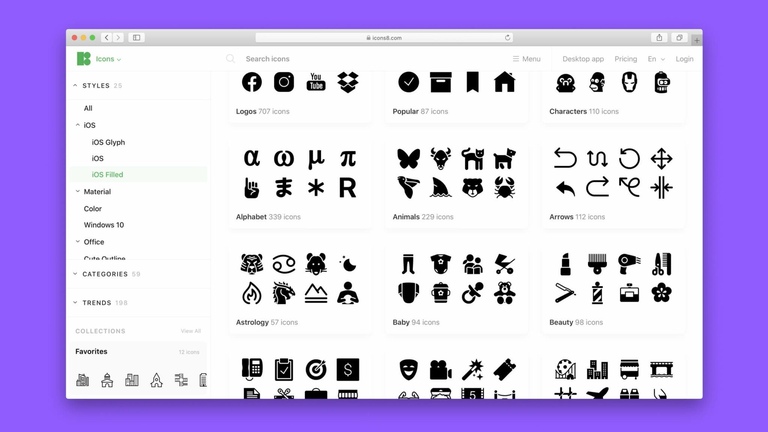
- Icons8 for customizable icon templates when you’re out of ideas
Common Mistakes and How to Avoid Them
I’ve reviewed over 200 sites this year, and these favicon fails keep showing up:
- The “I only uploaded one size” disaster: Browsers will stretch your tiny favicon into oblivion on different devices
- The “What’s a touch icon?” catastrophe: Your site looks professional until someone adds to the homescreen and gets a blank square
- The “Let’s use our whole detailed logo” tragedy: No one can tell what that pixelated blob is supposed to be
- The “Light icon on light tabs” invisibility trick: Your white icon completely disappears on Chrome’s default theme
The easiest fix? Use a proper favicon generator that outputs the full set of files and the correct HTML. It takes literally 5 minutes and saves your brand from looking like it’s stuck in 2010.
The Future of Favicons
Favicons aren’t just static brand markers anymore—they’re evolving into functional micro-interfaces. Here’s what’s already happening:
- PWA integration is making favicons crucial for app-like experiences
- Animated SVG favicons are starting to appear (when used tastefully, not like some GeoCities flashback nightmare)
- AI-generated contextual favicons that adapt to user behavior (like showing different icons based on your most-used feature)
- Browser personalization in Arc and Vivaldi lets users customize favicons in their collections
The most interesting development? Favicons are becoming less about “branding” and more about “wayfinding“—helping users navigate their increasingly complex digital environments.
Small Icon, Big Impact
Your favicon might be the smallest part of your site, but it’s often the first thing people see—and the asset they’ll interact with most frequently. It’s the difference between “which tab was that site on again?” and instant recognition.
Take 20 minutes today to audit your favicon. Is it recognizable at a glance? Does it work across light and dark modes? Can you identify it in a sea of 30 open tabs? If not, now you know exactly how to fix it.
The smallest part of your brand might just be doing the heaviest lifting. Don’t half-ass it.