

Safari has always been one of Apple’s most ambitious projects. The browser has also regained its position in the web browser market in recent years. But do you wonder how Safari fares in ranking and other quantitative measures? This knowledge can help you understand the future of Safari on your iPhone, iPad, and Mac.
In this guide, I will share some of the trending Safari browser statistics that matter in 2026.
General Safari Browser Statistics and Facts
Here are some impressive stats and facts about the Safari web browser.
- Safari is the second most popular web browser globally, just behind Google Chrome.
- Its seamless compatibility with Apple devices contributes to its popularity.
- Before Safari’s introduction in 2003, Navigator was the default browser for Macintosh systems.
- Steve Jobs had another name in mind for Safari: Freedom.
- About one-third of internet users in North America reportedly use Safari as their default browser.

- Although a Windows version was available for a few years, Safari is now exclusive to Apple devices.
- In recent releases, Apple has focused on the security and privacy aspects of the Safari browser.
- Even on macOS devices, Safari faces tight competition from Google Chrome.
- Safari lets people use many Apple-exclusive features, such as Handoff.
- Safari is also known as the go-to Mac browser for performance.
While these are interesting, we will see how Safari performs in terms of market share.
Safari Market Share Worldwide
Here are some statistics and insights about Safari’s worldwide market share.
- As of May 2026, Safari holds a global market share of 18.17%, placing it behind Google Chrome but ahead of Microsoft Edge.
- In the United States, Safari performs even better, boasting a market share of 32.1%.
- However, Safari struggles to maintain a market share of more than 3% in regions like South Asia such as India.
- In the mobile browser market, Safari has a market share of 23.47%, followed by Samsung Internet at 4.44%.

- Safari’s market share in the mobile sector has been somewhat stable for the past few years.
- Even though there were some dips and rises, the overall market share of Safari in mobile devices has remained the same between 2014 and 2026.
- Safari has a relatively lower market share of 8.8% worldwide in the desktop browser market. In this case, Microsoft Edge has surpassed Safari’s market share.
- Safari holds a dominant market share of approximately 90% on iPhone and iPad devices.
- However, the market share on macOS drops to around 55–60% due to the popularity of alternative browsers like Google Chrome and Firefox among macOS users.
- Even though Safari has a lower market share in some Asian markets, this trend doesn’t hold for all countries.
- Safari enjoys a higher market share in nations like Japan and South Korea, where iPhones are popular.
- Additionally, Safari has a significant presence in the tablet sector, thanks to the growing popularity of iPads.
- Safari enjoys a better market share in specialized markets such as enterprise and education.
- Educational institutions use Safari as the default browser for enhanced security and privacy.
- Similarly, enterprise users rely on this web browser to protect their business transactions from potential threats.
Number of Safari Users – last 10 Years
- According to statistics in 2026, Safari has a recorded user base of 1 billion worldwide.
- Out of these, 200 to 250 million desktop users use Safari on macOS.
- The number of mobile users is 800 million, mainly due to the widespread use of iPhones worldwide.
- Compared to other companies, Safari has a better market penetration rate, especially in the mobile sector.
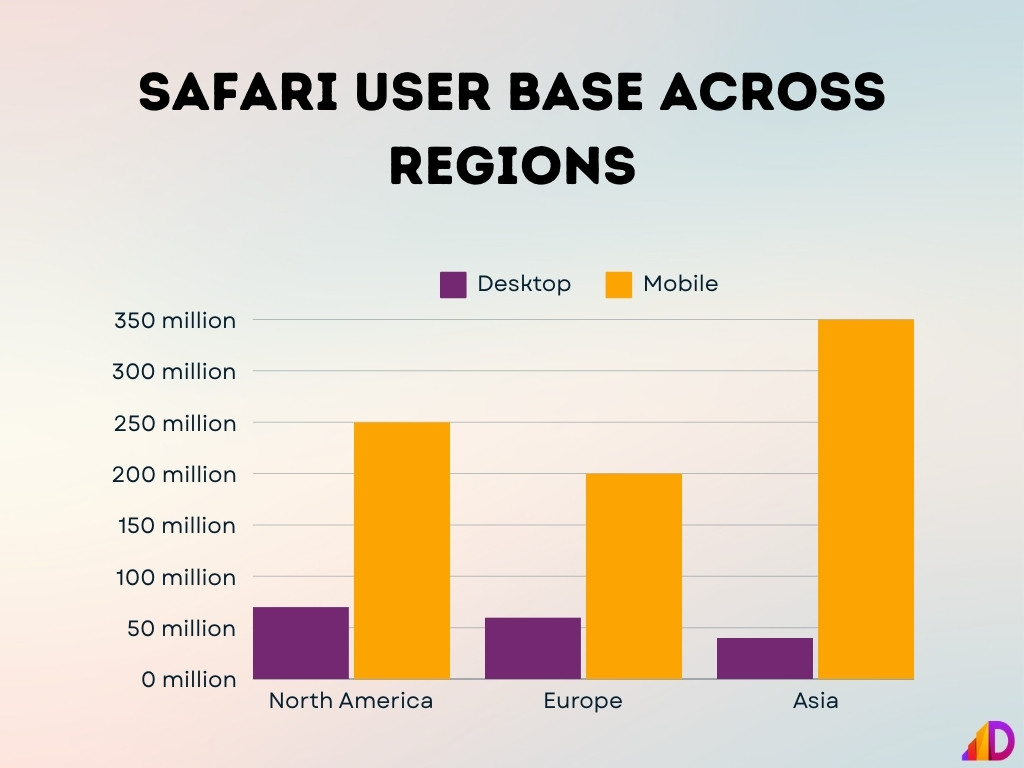
- In North America, Safari has around 70 million desktop and 250 million mobile users.
- The desktop user base in Europe is 60 million strong, whereas the mobile user base ranges from 150 to 200 million.
- However, the starkest difference is in Asia, where there are only 30 to 40 million desktop users of Safari.
- Nonetheless, there is a substantial number of mobile users for Safari, at 350 million.
- The distribution of these numbers generally depends on the popularity of Apple devices in each region.
- The combined user base of Safari in the United States means that 1 in 3 people you meet will likely prefer Safari over other browsers.
Safari Browser Usage Statistics
This part offers a quick look at Safari’s usage patterns.
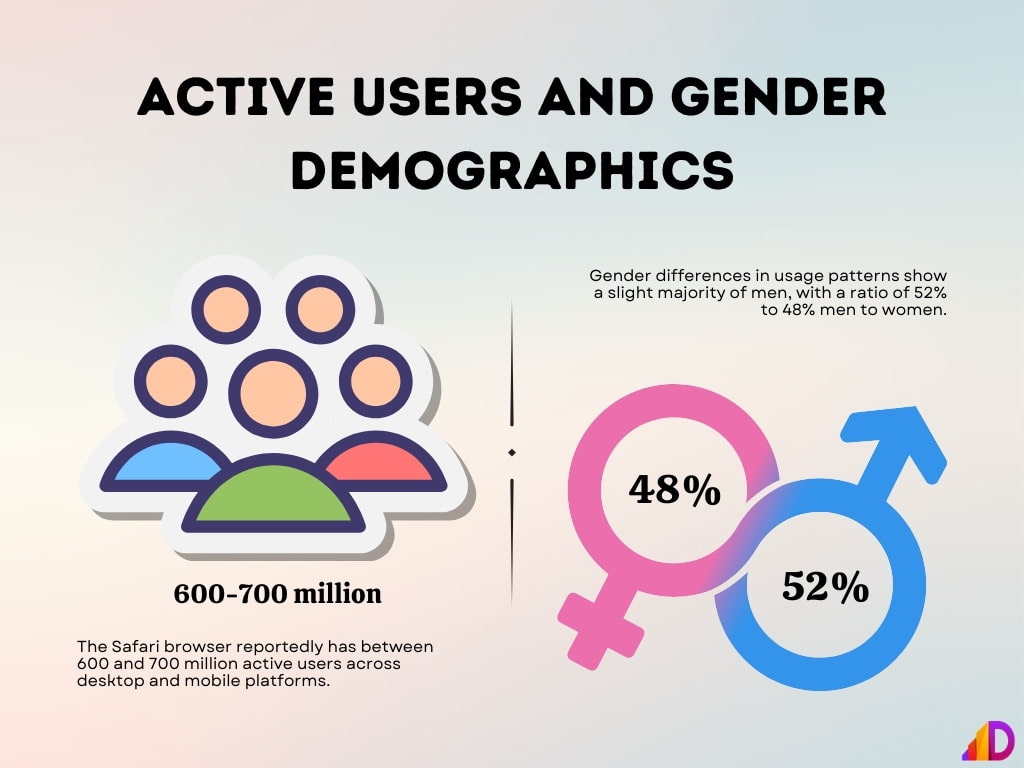
- The Safari browser reportedly has between 600 and 700 million active users across desktop and mobile platforms.
- The average session length on Safari is around 10-15 minutes.
- The most extensive user base falls within the 25-34 age range, while it becomes a less popular choice among users aged 45-54.
- Gender differences in usage patterns show a slight majority of men, with a ratio of 52% to 48% men to women.
- On average, a Safari user will have around eight tabs open per session.
- Additionally, bookmarks are notably popular among Safari users, with the average user likely to have around 50-100 bookmarks.
- Safari users spend most of their time on platforms like Instagram, Twitter, and Facebook.
- Online shopping platforms like eBay and Amazon are popular, engaging around 50% of the Safari user base.
- In contrast, the use of streaming services like YouTube, Netflix, and Hulu is minimal among Safari users.
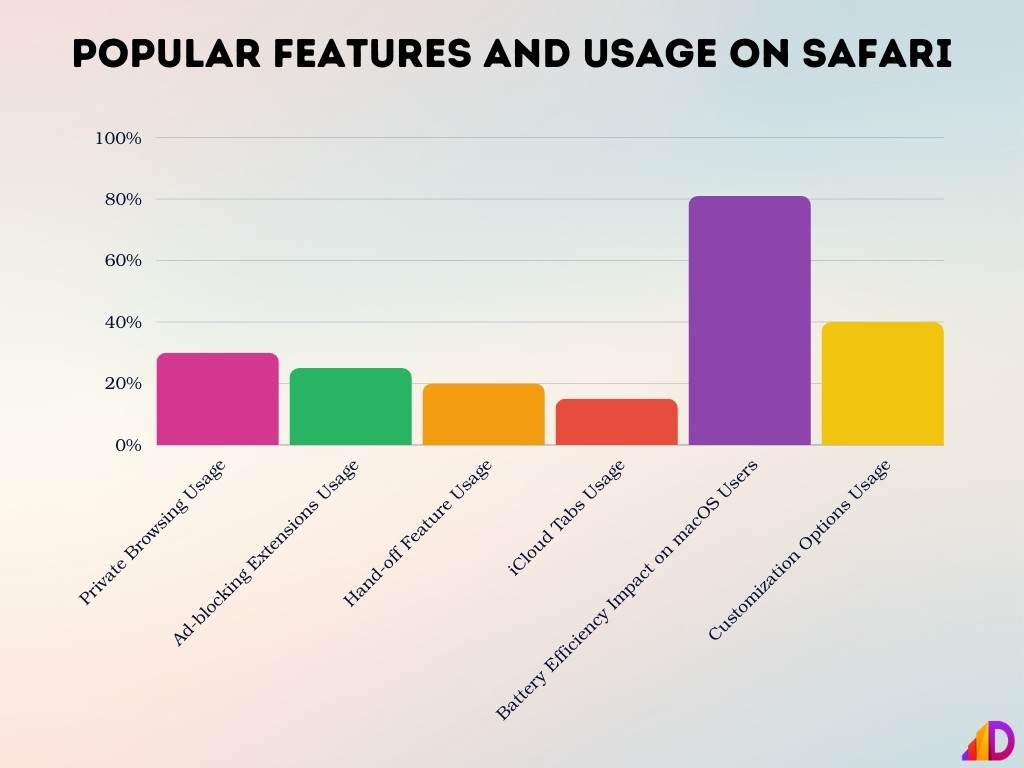
- Private browsing is one of the most popular features on Safari, with 30% of the user base occasionally using it.
- Ad-blocking extensions are also widely used on the browser, with 25% of the user base reporting that they use them.
- Apple’s cross-device synchronization features are also popular among Safari users. Specifically, 20% of users leverage the hand-off feature regularly, and 15% frequently use iCloud tabs.
- Safari’s battery efficiency is another reason macOS users rely heavily on this browser, with 80% of Mac users reporting improved battery backup after switching to Safari.
- Additionally, customization options within Safari appeal to a significant portion of its user base, with 40% of users taking advantage of these features.
- Usage pattern research from Safari also shows that customers will likely check out new features within six months of release.
Safari Revenue Statistics
Have you ever wondered how Safari makes money? Here are some answers.
- Safari generates revenue by enhancing the Apple ecosystem within iOS, iPadOS, and MacOS devices.
- As a free app, it doesn’t receive direct revenue.
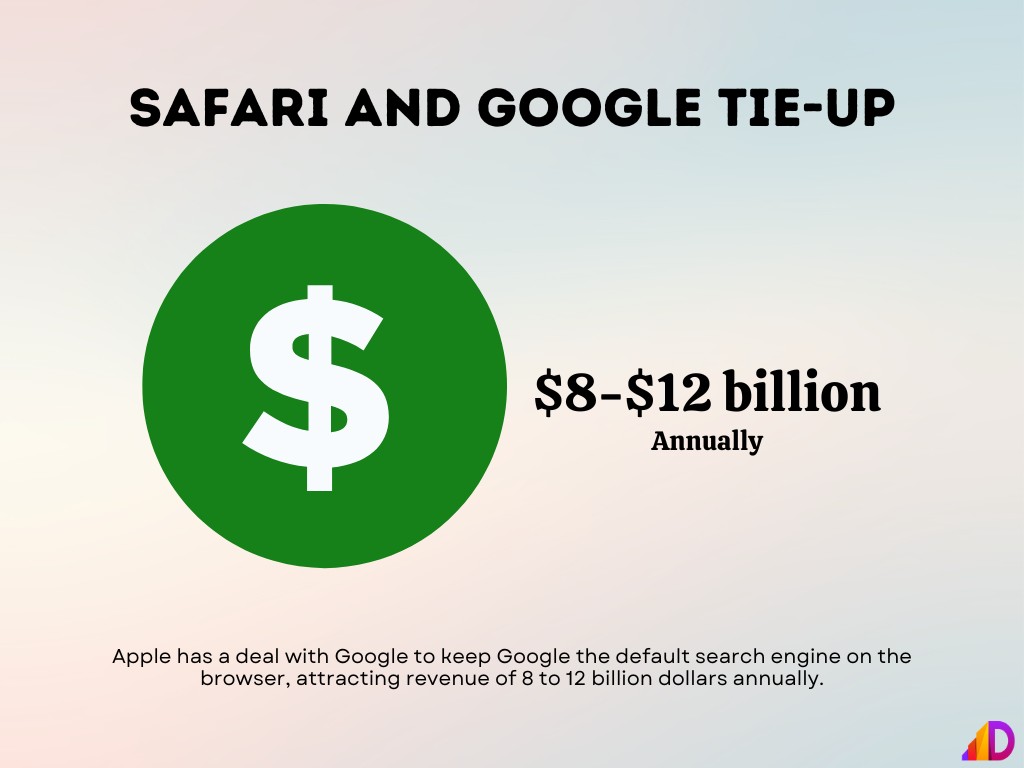
- However, Apple has a deal with Google to keep Google the default search engine on the browser, attracting revenue of 8 to 12 billion dollars annually.
- Safari may also gain some revenue by forwarding users to the App Store, where Apple charges a commission for every purchase.
- Additionally, Safari can enhance revenue by promoting Apple services such as iCloud and Apple TV+.
Safari Security Statistics
- Since its introduction in 2017, Intelligent Tracking Prevention has become popular in Safari. Many studies have reported that this system effectively blocks three-fourths of all web trackers.
- The sandboxing technology on Safari ensures that your devices are not directly affected.
- The PWN2OWN competition is one way Safari identifies potential vulnerabilities, which are patched within weeks.
- Regular security updates for Safari are released as software and app updates.
- The HTTPS adoption feature has improved the security of transactions over the web.
- Due to these security features, Safari enjoys a better trust rating than other web browsers.
- The browser has also received a user satisfaction rating of 85%.

Conclusion
These statistics show why Safari remains one of the most popular choices for MacOS, iOS, and iPadOS devices.
In my personal experience, the reason for using Safari was always the well-integrated design. This is especially true when using features like continuity or handoff between my Apple devices.
However, the lack of availability on Windows is a concern, especially for those who do not own a Mac.

6 Comments
I’ve been tracking Safari’s journey for a while now, and it’s fascinating to see how it has evolved over the last decade. The section on the number of Safari users over the last 10 years caught my attention. It’s impressive how Safari has managed to hold its ground despite stiff competition from browsers like Chrome and Firefox. I’m curious about the factors that have contributed to its sustained popularity. Is it the seamless integration with iOS and MacOS that keeps users hooked, or is there more to the story?
You’re absolutely right—Safari’s seamless integration with iOS and macOS is a key factor in its popularity. Its focus on privacy, features like Intelligent Tracking Prevention, and excellent energy efficiency also play a big role.
Yeah, I wonder if it’s just ppl with iPhones and Macs who stick to Safari, or if others switch over to it too? Any data on that?
Great question! While Safari is most popular among iPhone and Mac users due to its integration with the Apple ecosystem, it’s also gaining traction among other users, especially with its increasing focus on privacy and performance. However, the majority of Safari’s user base still comes from Apple device owners. I’ll keep an eye out for more data on this and share it when available!
It’s mostly about the ecosystem, in my opinion. Once you’re in Apple’s ecosystem, Safari becomes the go-to due to better battery efficiency and optimization. But sure, I’d love to see actual stats on browser switches.
Really appreciated the segment on Safari Security Statistics. In times where data privacy seems like a myth, it’s refreshing to see browsers putting in the work to safeguard user data. Great article, Rajesh.